Secures clarity for producers regarding the Biden-era methane rule
Washington, D.C. — Congresswoman Julie Fedorchak (R-ND), a member of the House Energy and Commerce Committee, today questioned Environmental Protection Agency (EPA) Administrator Lee Zeldin during a hearing titled, “The Fiscal Year 2027 Environmental Protection Agency Budget.” Fedorchak highlighted her January 2025 letter to the Trump administration, detailing 20 federal rules that drove up costs, threatened grid reliability, and put North Dakota energy workers at a disadvantage. Today, 17 of those regulations—many of which fall under EPA jurisdiction—have been fully repealed, withdrawn, vacated by courts, or are actively being rolled back.
In her questioning, Fedorchak secured clarity for North Dakota producers regarding the Biden-era methane rule—one of the rules she outlined in the January 2025 letter—set to take effect in the coming days. After raising concerns that the rule could force operators to shut in up to 40,000 barrels of oil per day, Administrator Zeldin confirmed that EPA is preparing guidance—expected to be released before the May 7, 2026, compliance deadline—that will fully address these concerns. Zeldin emphasized the agency is “extremely confident” the forthcoming guidance will assist producers in interpreting and complying with the rule, providing reassurance that immediate production shut-ins should not be necessary.
Fedorchak also asked Zeldin about the New Source Review program, emphasizing that current rules discourage modernization. She highlighted the New Source Review Permitting Improvement Act, legislation she is leading alongside Rep. Morgan Griffith (R-VA), and asked how streamlining the process could unlock investment and reduce emissions.
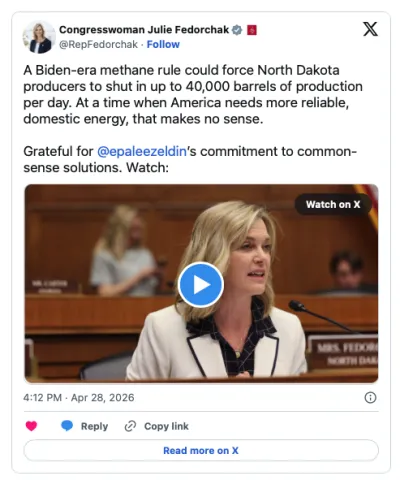
Check out these highlights for her questioning, edited for clarity:
Rep. Fedorchak: On my first day in office, I wrote a letter to President Trump and Secretary Burgum, urging them to focus on 20 onerous Biden-era regulations that directly targeted energy producers. These rules drove up costs for Americans and made our energy supply more vulnerable. Of those 20, 17 have now been repealed, withdrawn, vacated, or are being addressed—many under EPA’s jurisdiction. That includes the carbon rule, Clean Power Plan 2.0, WOTUS, MATS, and the methane emissions charge. Americans are already benefiting from more reliable energy as a result, so thank you for your work.
One rule that remains will have an impact in just nine days. There is a compliance deadline on the Biden-era methane rule, and North Dakota operators tell me it could immediately shut in 20,000 to 40,000 barrels per day of production and limit drilling outside the core Bakken. At the same time, President Trump signed a Defense Production Act determination on April 20 directing expanded domestic petroleum production as essential to national defense. As EPA Administrator, how do you plan to reconcile these directives before May 7?
Administrator Zeldin: We are preparing a guidance document to put out as soon as this week. It will definitely be released before May 7 and will address this concern.
Rep. Fedorchak: Will that potentially extend the May 7 compliance deadline?
Administrator Zeldin: It will directly address—fully address—the concerns that have been expressed on this issue.
Rep. Fedorchak: So, my producers should not be preparing to shut in that production?
Administrator Zeldin: We are well aware of the issue, and we are extremely confident that the document we will be putting out will assist the regulated community in interpreting the law and regulation.
Rep. Fedorchak: Excellent. Thank you, Mr. Zeldin. I’d like to turn to New Source Review. As currently structured, the program penalizes facilities for trying to modernize. Representative Griffith’s New Source Review Permitting Improvement Act addresses this directly, and I’m proud to support it. Can you speak to how streamlining New Source Review could unlock investment in modernization across the energy sector while also reducing emissions?
Administrator Zeldin: We’ve received feedback over the past 15 months on ways to improve the program—some of which do not require new rulemaking. For example, we issued guidance clarifying what “begin actual construction” means. That allows companies to build certain parts of a facility, as long as they do not cross specific thresholds related to emissions units. We’ve also allowed companies, at their own risk, to begin construction while going through the permitting process. We’ve been responsive to requests for further improvements, including actions that may require rulemaking, and we are considering those next steps.
Rep. Fedorchak: Would additional direction from Congress help you go further?
Administrator Zeldin: Absolutely. The Clean Air Act, passed decades ago, includes opportunities for modernization. We have a list of ideas from the White House Council on Environmental Quality, and EPA has additional ideas beyond that. We look forward to working with Congress to implement any statutory changes that would help us go further.
Rep. Fedorchak: Thank you, Mr. Zeldin. I appreciate your leadership. This is a common-sense area for improvement.