Bismarck, ND — From a rural K–8 school near Mandan to North Dakota’s workforce-focused polytechnic institution, Congresswoman Julie Fedorchak (R-ND) and U.S. Secretary of Education Linda McMahon highlighted Thursday why education decisions are best made by the parents, teachers, and local leaders closest to students—not federal bureaucrats in Washington.
During visits to Bismarck State College and Sweet Briar School, Fedorchak and McMahon discussed efforts to return education authority to states and communities, reduce federal red tape, strengthen workforce preparation, and expand educational opportunities for families. Fedorchak said success of the decentralization effort depends on the federal government eliminating as many strings attached to the funding as possible, freeing states to focus dollars on the most urgent needs. She also highlighted the new Education Freedom Tax Credit she supported and helped enact through the Working Families Tax Cuts.
“Sweet Briar School and Bismarck State College serve different students, face different challenges, and succeed in different ways—and that’s the point,” Fedorchak said. “One-size-fits-all solutions for education don’twork. North Dakota parents, teachers, and local leaders know what their students need better than federal bureaucrats in Washington. Secretary McMahon understands that, and I’m grateful she came to see firsthand how local leadership, flexibility, and innovation are preparing our students to succeed."
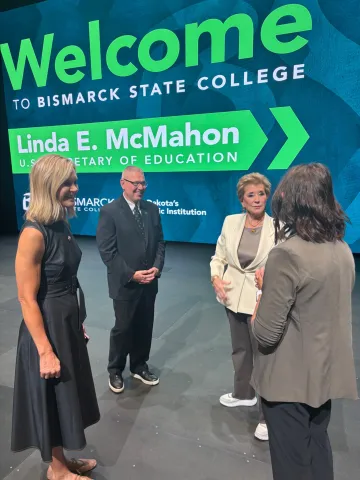
At Bismarck State College, Fedorchak and McMahon met with students, instructors, administrators, and workforce partners and toured the Polytechnic Institute. Their discussion highlighted BSC’s hands-on approach to education and its partnerships with North Dakota employers to prepare students for high-demand careers. As North Dakota’s polytechnic institution, BSC offers more than 100 certificate, associate, and bachelor’s degree programs. BSC has seen extraordinary growth in recent years, increasing enrollment by 46% since spring 2022.
The visit continued at Sweet Briar School, a rural public school serving students in kindergarten through eighth grade near Mandan. Fedorchak and McMahon visited with teachers, students, and school leaders about the strengths and challenges of rural education and the importance of giving local educators the flexibility to meet the needs of their students.


Secretary McMahon’s visit was part of her nationwide Returning Education to the States Tour. She is visiting all 50 states to hear directly from teachers, parents, students, and community leaders about successful local approaches to education and to identify best practices that can be shared nationwide.
Education Freedom Tax Credit Coming in 2027
Fedorchak also discussed the implementation of the Education Freedom Tax Credit, which will become available beginning in January 2027. Governor Kelly Armstrong announced in January that North Dakota will participate in the program.
The credit will allow individual taxpayers to receive a dollar-for-dollar federal tax credit of up to $1,700 per year for cash contributions to an approved Scholarship Granting Organization. Those nonprofit organizations will use the contributions to provide scholarships for eligible K–12 students in North Dakota.
Parents can use the scholarships for educational expenses at public, private, or religious schools, including:
Tuition and fees;
Academic tutoring;
Books, supplies, and educational technology;
Services for students with disabilities;
Career and technical education equipment or uniforms; and
Other eligible supplemental educational services.
Eligible students must be able to enroll in a public elementary or secondary school and come from a household earning no more than 300 percent of the area median income. Scholarship amounts will be determined by participating Scholarship Granting Organizations and are not limited to $1,700.
“This new tax credit will bring more educational opportunities within reach for many North Dakota students,” Fedorchak said. “It encourages private donations that can help families pay for tutoring, special-needs services, technology, career training, tuition, and other educational expenses. Most importantly, it gives parents more freedom to choose opportunities that fit their child.”
Before taxpayers can claim the credit, North Dakota must submit a list of approved Scholarship Granting Organizations to the U.S. Department of Treasury. Treasury is scheduled to release the full list of rules governing the program by the end of September, and Fedorchak is urging them to complete the guidance soon, so the state has time to prepare for the January implementation.Taxpayers may begin claiming the credit for qualifying contributions made in January 2027.