“We really aren’t ‘transitioning,’ we’re expanding”
Washington, D.C. — Congresswoman Julie Fedorchak (R-ND) joined Axios reporter Hans Nichols this week for a conversation titled, “Electricity in Transition: Strengthening the Grid for What’s Next.” Fedorchak emphasized the importance of prioritizing reliability and affordability, the need for fair cost allocation principles, and the urgency of bipartisan permitting reform. Check out highlights from the event below:
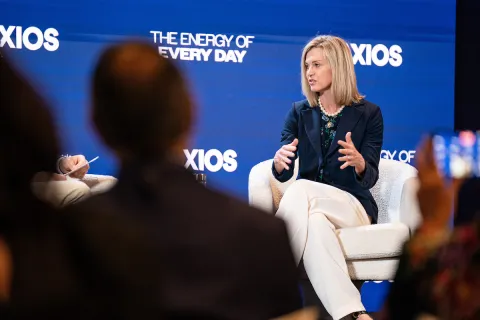
On how North Dakota achieved the lowest utility rates in the country:
Getting back to the title of the event today, “Electricity in Transition,” in North Dakota we looked at this more as energy expansion.
That’s a mentality our whole country needs to have. We really aren’t “transitioning,” we’re expanding. And we need to expand faster than we ever have in the past.
In North Dakota we’ve always stuck to the fundamentals, which is why we have the lowest rates in the country.
In order to have low prices, you have to put reliability and affordability first. So, we always focused on that for our rate cases.
On structural advantages of energy market deregulation:
We didn't really have the opportunity to look at deregulation in our state.
We have 850,000 people in our whole state, so it really isn't a market that would lend itself to competition and deregulation.
I do think the vertically integrated markets have some advantages—you have a regulator who is looking at them and helping companies make those decisions, and you have a more direct connection to the reliability issue.
That is a little trickier in the competitive markets.
On what Washington doesn't understand at a state level:
One of the reasons why I wanted to do this job is because I wanted to have somebody with my background in the mix out here at this time, and I think it's similar to what I just said: we have to get more serious about building things quickly.
One of the main things we need is good, strong signals to the market.
I felt that it was important, number one, to eliminate the production tax credits for wind and solar after 30 years, and we did that.
It's commonsense policies like that—recognizing that we have to start sending the signals to get the energy that we need into the market.
On potential rate increases from hyperscalers:
[The hyperscalers] should absolutely pay for all of their costs.
I've heard it over and over again from those companies, that they're willing to do that and want to do that.
In North Dakota, we've already done some of that, where you've had some excess energy, and the companies have connected to those places.
They're sucking up excess wind or areas where there's congestion on the grid, pulling that energy, using it for AI, and lowering rates.
This notion that we're going to have rates explode, and that senior citizens in our country who are on fixed incomes are going to have to pay for this, is very false. It doesn't have to be that way.
On addressing rising energy demand for AI:
We have several big ones [in North Dakota], and we would love more because we're flaring gas, so we have the ability to generate a lot more power quickly.
So, it's those types of things:
Going to the source where the power is.
Going to the generators that are considering coming offline but shouldn't be coming offline early—we shouldn't be retiring anything from the US right now.
Going to the nuclear facilities that have come offline and bringing those back on, which is happening.
We should be going to every single generator and seeing how much more we can get out of these with newer technologies and more efficiency—just simple gains.
I think we can address a lot of this demand with resources that are already on the grid, like North Dakota has flared gas that could be turned into gas fired power in pretty short order and paid for by the people who need it.
On changing current price signal models in the future:
One of the changes that is really important to make, and hasn't been done because we haven't connected such large demand up all at once, is they need to pay upfront.
Understanding how to make the commitment to a load that might not materialize, that's risky.
So, changing some of the models for connecting large loads is important.
On fair cost allocation formulas:
Absolutely. Having the cost allocation correct in transmission is also really important.
Socializing those costs to everybody as postage stamp is the wrong way to do that.
You have to be able to segregate who needs it, and how we can create a formula that helps them pay the cost of their percentage of the need.
On a realistic outlook for permitting reform:
It already is happening—but it’s not done.
The PERMIT Act and the SPEED Act are over at the Senate now, and our goal is to give the Senate a whole menu of options to pull together the really essential bipartisan package that's needed in the Senate to get the 60 votes.
This is urgent.
I know there's Democrats that want to do this. I've talked to them, and even the Democrats recognize that this is the best time to do this.
If we wait till the next Congress, it's going to be too late, and you probably won't have the political dynamics to get it done.
On cost allocation concerns arising from blue states like Minnesota:
We are concerned about that. In fact, North Dakota has a case in front of FERC right now where we're protesting the MISO cost allocation for one of their long-range transmission planning tranches.
And it's for that very reason—the expansion has been designed to help bring on the power needed for states like Minnesota to meet their goals, and those aren't the goals in my state of North Dakota.
Paying for, on a postage stamp basis, all of those costs isn't fair, and so we're protesting that with FERC.
[MISO] had an alternative that was more of a generator-paid type formula, where the generators would pay a portion of the cost of the line, and that would be baked into their costs. That was rejected, but that's a formula that I think still makes some sense and could be part of the longer-term conversation.
On what the federal government can do to solve cost allocation issues:
I have proposed a bill called the FAIR Act that would prevent this from happening.
The bill says that on any cross-state projects, you cannot assign the cost for policy-driven projects to states that don't have those policies.
That bill is in the mix. I've talked to the Senate negotiators about that bill, and there's a decent number of folks who like that.
It's a more of a Republican approach to cost allocation, and I think they recognize, and I do too, that the bill might be a starting point and a negotiating tool.
On the single most important title in permitting reform legislation:
Wow, that's pretty tough. I'm going to assume that other people will pick different ones, and they'll get some too, because NEPA reform and judicial reform are vital.
But I think the big piece that there isn't solution for yet, that I feel like we can get done, is cost allocation.
Finding a way to make sure that the folks that are driving the need for these massive investments in transmission are paying for them, and that we do not postage stamp those to all American citizens.