Washington, D.C. — During a discussion on permitting reform and increasing AI-driven power demand, Congresswoman Julie Fedorchak (R-ND) emphasized that U.S. policy must focus on stabilizing, optimizing, and growing our energy resources. She highlighted the need to streamline federal processes, strengthen grid reliability, and ensure fair cost allocation across states.
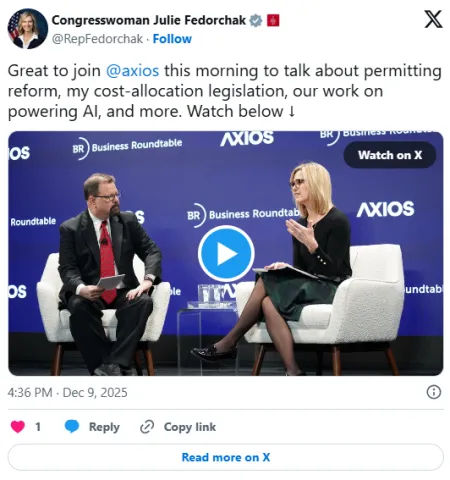
On why permitting reform is critical in the context of China:
I think the fact that the audience is almost full and it's eight o'clock in the morning on a cold day speaks to the importance of permitting reform.
When I look at the U.S. and some of our challenges, China is a country of engineers and builders, and we’ve become a country of lawyers. We have to flip that, because we have unprecedented needs for power and other goods and services in our country.
We're almost paralyzed in our ability to build linear infrastructure in our country.
We need a lot of it to meet this demand, so that's why we're here.
On her AI & Energy Working Group:
I come to this job as a 12-year state utility regulator, the most recent president of NARUC—the National Association of State Utility Regulators—and eight years as a liaison for our state to the MISO region. So, tons of experience with power. During that time, I realized how much more power we need because my state started seeing requests for more power generation for AI.
That became a big topic among state regulators across the country: how are we going to meet this demand? So, it was natural for my team to say, “Hey, you've got a unique skill set here. Why don't we start this working group to tackle this issue and try to provide some leadership on it?”
First, by asking for information. So, we made a request for information for folks, got 100 replies, and then we've taken that information and kind of consolidated it around three big issues: how do we stabilize our grid and stop the bleeding, how do we optimize what we've got, and then how do we grow?
On her Promoting Cross-Border Energy Infrastructure Act and potential concerns regarding environmental review exemptions:
All of the environmental review processes remain intact from that bill.
It just streamlines who's in charge of them, and it takes the politics out of it.
Keystone XL was obviously the poster child for that bill. But it could also apply to transmission lines or power lines going across the border, if there was some controversial one or one that folks wanted to pull back on or try to prevent. [My bill] tries to take that off the table and provide certainty.
[During my time] as a state utility regulator, we permitted right during the Bakken oil boom. I was involved in permitting $13 billion worth of energy infrastructure, and the one message I heard loud and clear from industry was the need for certainty.
I tried to apply that as my job as a regulator, just very fairly, like apply the law. Keep it certain. Don't throw any curve balls. And that's what industry needs, and that's what we need to bake into the law in some of the processes on the federal side.
On the impetus behind her FAIR Act:
Again, coming from my experience as a state liaison to MISO for eight years, MISO is one of the biggest grid operators. Runs the grid in the central part of the country from North Dakota to Texas, a 15-state region with 32 million customers. They're in a massive build-out of power lines, which we all know are needed, but the driver of those lines is important, and who pays for them is even more important.
How you do that matters because it sends signals down the road for how future lines get built.
There's a lot of different drivers for the need for power lines, and they get baked into rates, and utilities earn money on them, so there is a vested interest in trying to build because it does help you increase your rate base and make more earnings. So, you need to balance that all out.
When it comes to cost allocation—which is not permitting reform—I wanted to have a Republican take on cost allocation in the mix, so that we could look at it from that standpoint.
The biggest thing in the energy sector is sending the right signals, and those drive investment decisions. They also drive costs and affordability, and those are all big issues.
This is an attempt to say, what are the cost causes? And if you're causing the need for a line, then you should pay for it, and that's what the FAIR Act does.
On reforming New Source Reviews:
New Source Review is an issue that has really locked up some good decisions.
If you've got a power plant—whether it's a natural gas plant or maybe a coal facility, you want to convert its power to gas. The New Source Review could prevent you from doing that and create more inefficiencies in existing infrastructure.
One of the most obvious things we need to do quickly is maximize our existing resources—get the most out of them that we possibly can. New Source Review can prohibit that because it can trigger new environmental impact reviews for upgrading those facilities and higher standards, and that's not what you want to be doing if you're trying to maximize your existing infrastructure.
I think we need to reform that and take away that disincentive.
On the PERMIT Act and SPEED Act:
When you look at permitting reform, NEPA and the Clean Water Act are the two big buckets of environmental review processes that hinder development of every resource, whether it's wind, solar, pipelines, or power lines.
They're all impacted, so streamlining those processes, creating more certainty, limiting timelines, addressing the judicial review processes, all of those are baked into these bills and take significant strides forward.
I saw it in some big projects in my state. NEPA can be a big challenge for folks, and the processes can drag out for years.
I was one of the two people in my state that approved the Dakota Access pipeline in North Dakota. That was in 2016, and it’s still in court. A lot of that was NEPA-related. Permits were vacated and then brought back. You really couldn't write it crazier than what has happened with that one.
So, this provides more certainty there, better timelines, more clarity.
I think most importantly, no matter what your favorite type of resource is, this applies to everything.
I think that's why it has bipartisan support. I'm hopeful that we can get that done, both the SPEED Act and the PERMIT Act as well.
On state vs federal authority:
The whole balance between state and federal rights as it relates to all of these energy issues is significant.
As state regulators, I understand you kind of hold your power and your authority tight, and you want to maintain that.
I think it's part of the broader discussion that we all need to have over those rights and the need: when is it appropriate for the federal government to step in from a national security issue or reliability issue, take action, and provide higher authority?
I think it's fair for the states to be asking that of FERC. I also think it's really important that we have this conversation and come to an agreement on when that is appropriate for the feds.
It also gets to the issue of reliability, whose responsibility is reliability? The state? The states have a big role to play, but our grid is interoperated. It doesn't recognize state boundaries, and so state actions affect the reliability of the whole thing. So, I think there's broader oversight there that also needs to be considered, and all of this is part of that discussion, which we need to have quickly.
###