Dear Friend,
As another growing season is underway, I’m reminded of the hardworking men and women who roll up their sleeves and work 365 days a year to feed and fuel the world. Thank you to our resilient farmers, ranchers, and producers in every corner of North Dakota.
Through my meetings with many of you, I’ve walked away with the same takeaways: North Dakotans are problem-solvers, but we need the federal government to get out of the way. You need expanded market access, tax certainty, a strong Farm Bill, and fewer burdensome regulations so rural America can do what it does best: feed and fuel the world.
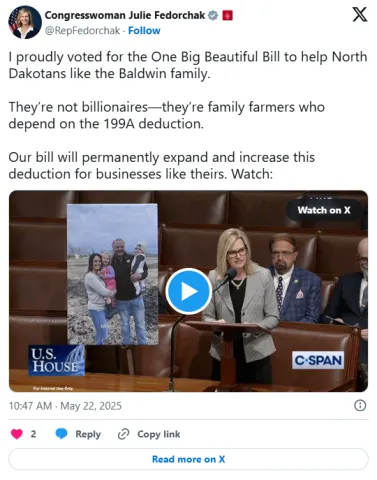
President Trump’s One Big Beautiful Bill aims to address these priorities by raising the Death Tax exemption, increasing the 199A small business deduction, and providing greater flexibility and financial certainty for family operations.
I shared the the story of Brent and Stephanie Baldwin during the House Floor debate on the bill. The Baldwins are fourth-generation farmers in St. Thomas, ND, who grow wheat, sugarbeets, edible beans, and soybeans while raising three kids. Like thousands of North Dakota producers, they rely on the 199A deduction—which is set to expire this year unless Congress acts. This bill will help families like the Baldwins—and you—keep more of what you earn and give you the tools to invest in the future.
In this special ag-focused newsletter, you’ll find updates on the issues that matter to our state’s number one industry. If you’d like more frequent updates, please subscribe to my monthly newsletter. I always appreciate hearing from you, so reach out anytime to share your thoughts. If you’d like me to pay a visit to your farm this summer or fall, let me know.
My Best,
Julie

Here’s how the House-passed One Big Beautiful Bill benefits North Dakota’s ag community:
Raises the Death Tax exemption so more families can pass down their farm or ranch to the next generation of ag leaders.
Raises the 199A small business deduction to 23 percent.
Expands flexibility for family farms to reinvest in equipment, inputs, and labor.
Renews 100 percent expensing for capital purchases so you can write off the cost of new machinery, infrastructure improvements, or production facilities right away.
Strengthens risk management tools to protect producers.
Supports beginning farmers and ranchers as they get their start.
Reforms and refocuses SNAP, giving states more responsibility over the program.

Right now, Congress is laser-focused getting the One Big Beautiful Bill signed into law. But immediately after the bill passes the Senate, we need to get the administration, the House, and the Senate focused on the Farm Bill. It's been kicked down the road too many times, and farmers need long-term certainty. Below is a non-exhaustive list of ag policy priorities my team has developed through our meetings with you:
Pushing for a strong, timely, and fiscally responsible 5-year Farm Bill with higher reference prices and better crop insurance (Included in the One Big Beautiful Bill).
Locking in tax provisions that North Dakota producers rely on. That includes extending the 199A deduction on qualified business income and supporting the Main Street Tax Certainty Act to make the 199A deduction permanent (Included in the One Big Beautiful Bill).
Supporting the Death Tax Repeal Act to permanently eliminate the death tax, which imposes an unfair and costly tax on the transfer of property, land, and other assets from a deceased family member to heirs of family farms and small businesses.
Protecting property rights. The Landowner Easement Rights Act—a bill I introduced with Rep. Harriet Hageman (R-WY)—will prohibit the Department of Interior from entering into new conservation easements exceeding 30 years and empowers landowners to renegotiate terms, renew agreements, or buy back conservation easements at fair market value.
Fixing federal aid for students from farm families through the Family Farm and Small Business Exemption Act, which would restore exemptions for family farms and small businesses under the Free Application for Federal Student Aid (FAFSA).
Working to address the H-2A Visa program, which if not adequately addressed, can place severe operational and financial pressure on North Dakota family farms.
Supporting biofuels, including allowing for the year-round sale of E-15. I was recently named Co-Chair of the Congressional Biofuels Caucus, where I’ll help advance policies that will help expand domestic energy production, empower rural America, and deliver practical solutions for North Dakotans.
Supporting appropriations requests for ag research and extension activities done by North Dakota State University.
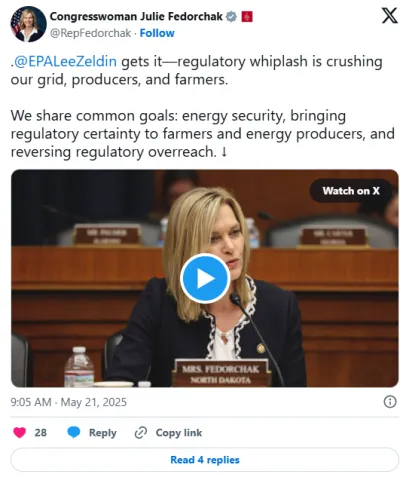
Advancing common sense regulatory reform such as revising the burdensome Waters of the United States (WOTUS) rule. This rule has been a political football for too long, and our producers need clear rules when it comes to clean water. I recently discussed this and other EPA deregulation efforts before the House Energy and Commerce Committee, and in a letter to President Trump and Secretary Burgum highlighting 20 burdensome regulations that should be rescinded. It’s a high priority for the Energy & Commerce Committee.

Here’s a roundup of some of my team’s agriculture-focused highlights from the past few months:
Hosted a virtual roundtable with House Committee on Agriculture Chairman Glenn “GT” Thompson (R-PA) and North Dakota agriculture leaders. Chair Thompson responded to concerns expressed by each of the eight groups represented and shared his commitment to passing a strong Farm Bill as quickly as possible. He emphasized the need to strengthen crop insurance, increase reference prices, and significantly increase money for the Market Access Program (MAP) and Foreign Market Development Program (FMD). I look forward to having him out in North Dakota for a “Boots and Blue Jeans” conversation!
Met with President Trump’s trade team from the Office of the United States Trade Representative (USTR) several times to discuss challenges North Dakota’s businesses, farmers, and energy producers face with tariffs.
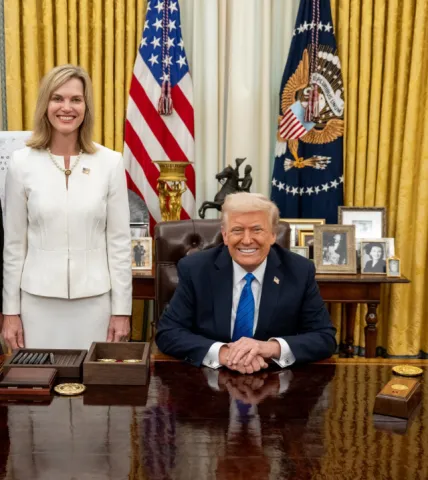
Invited President Trump to visit North Dakota to meet with our farmers this summer.
President Trump signed a historic trade deal with the U.K., which includes billions of dollars of increased market access for American exports. This deal will create a $5 billion opportunity for new exports for our farmers, ranchers, and producers, including more than $700 million in ethanol exports and $250 million in other agricultural products like beef. The U.K. will also eliminate discriminatory non-tariff barriers that have long restricted access for U.S. goods with the U.K. which includes billions of dollars of increased market access for American exports.
Highlighted chemicals that are vital to North Dakota farmers and ranchers at my first Energy & Commerce Environment Subcommittee hearing.
Met with North Dakota ag groups and leaders in D.C. and at home including:
-
North Dakota State University’s (NDSU) Saddle and Sirloin Club
VanBedaf Dairy Farm and Cows & Co Creamery
North Dakota Corn Growers Association at the Carrington Ag Research Center
NDSU’s Student Ag Ambassadors
Grand Farm Innovation Campus
American Crystal Sugar Company
North Dakota Dry Pea & Lentil Council
American Pulse Association
U.S. Pea & Lentil Trade Association
North Dakota Barley Council
Northland Potatoes North Dakota
Black Gold Farms North Dakota
North Dakota Potato Leadership participants
North Dakota Farmers Union
North Dakota leaders of the Livestock Marketing Association
North Dakota Soybean Association
North Dakota Grain Growers
North Dakota Corn Growers Association
McKenzie County Grazing Association
North Dakota Grazing Land Coalition
North Dakota Stockmen’s Association
North Dakota Ethanol Producers Association
National Grain and Feed Association
Midwest Dry Bean Coalition
North American Millers Association

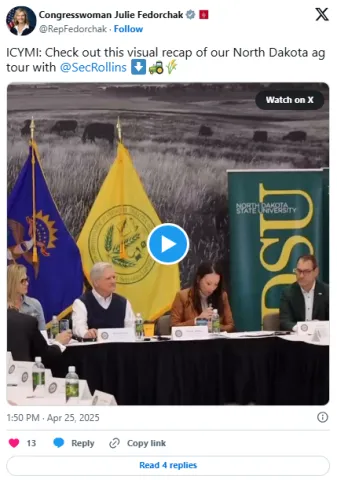
In April, U.S. Secretary of Agriculture Brooke Rollins visited North Dakota to spotlight how our state is leading the way—not just in growing crops and raising cattle, but also in developing innovative technologies to do it better. The ag tour included:
A roundtable discussion at NDSU with Secretary Rollins, Senator Hoeven, Governor Armstrong, Ag Commissioner Doug Goehring, and North Dakota producers, researchers, and business leaders to talk through the most pressing issues facing farm country. Top of mind in the discussion was the need for long-term certainty, especially when it comes to regulations and markets.
Lunch with NDSU’s Student Ag Ambassadors and a conversation about the future of farming and agribusiness in North Dakota.
A demonstration showcase of the latest innovations in precision agriculture at the Grand Farm Innovation Campus in Wheatland.
A tour of the American Crystal Sugar Company processing plant in Moorhead, where we saw how North Dakota sugar beet growers are adding value to a key crop and supporting jobs, co-ops, and rural economies across the region.
Click here for a full recap of the day.
Serving you in Congress is the honor of my lifetime. Thank you for what you do as the backbone of our great state. Our rural heritage and connection to the land is our greatest asset. Staying connected to our land and our natural resources will not only keep our economy strong, but it will keep our people strong, resilient, and driven by common sense. Please subscribe here to continue receiving these updates and follow me on Facebook, Instagram, and Twitter for daily updates. Please reach out to my D.C. office at (202) 225-2611 or email me through my website to share your thoughts on pressing issues. If you are in need of assistance with a federal agency, my offices in North Dakota are here to help. For more information, please visit our website here. |
| My Best, |

Julie Fedorchak
Member of Congress